- The Warm Up
- Posts
- How To Pick Exercises

“If an exercise is important enough to do, it’s important enough to do often.”
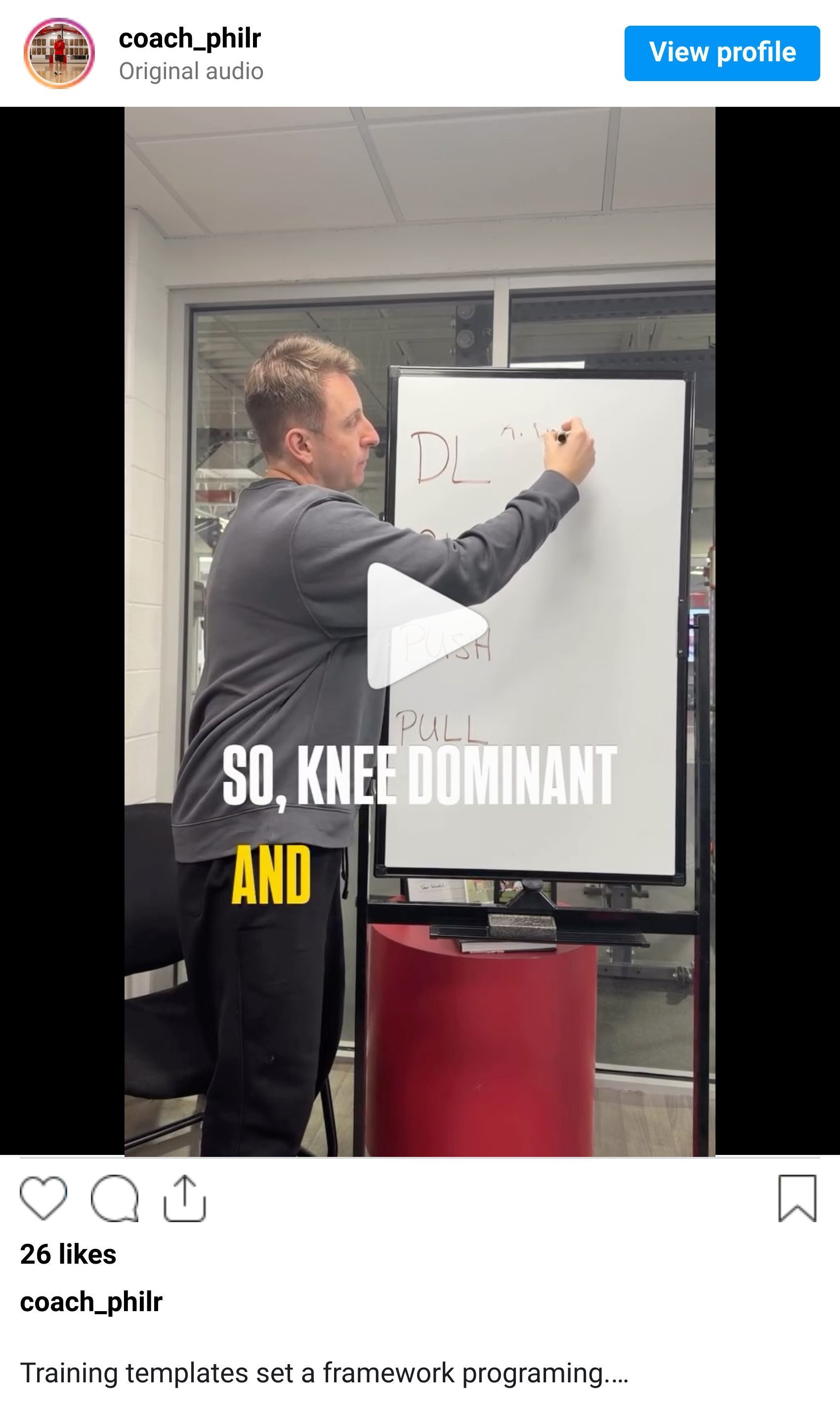
Double Leg
I start by selecting a double-leg exercise. This includes any movement where both feet are firmly on the ground and the stance does not change. Think squats, deadlifts, or glute bridges.
From there, I break double-leg movements into two categories: knee-dominant and hip-dominant. The main difference comes down to shin angle. The more vertical the shin, the more hip-dominant the movement. A stiff-leg deadlift (RDL) is a good example. A more forward shin angle shifts the emphasis toward the knee, like in a forward lunge.
Single Leg
Single-leg movements are exactly what they sound like, one leg is doing most of the work. Exercise selection here rotates based on the time of year, training age, and sport.
I categorize single-leg exercises the same way as double-leg movements: knee-dominant and hip-dominant, again based on shin angle. I keep a database of both to make programming simple and flexible.
Often, I’ll pair the single-leg emphasis with the opposite of the double-leg movement. For example, if the double-leg exercise is a stiff-leg deadlift (hip-dominant), I’ll pair it with a more knee-dominant single-leg movement.
Upper Body Push
For upper-body pushing, I split movements into horizontal (like the bench press) and vertical (like the shoulder press). Over the course of a training cycle, I make sure these are balanced based on the athlete’s goals.
Upper Body Pull
Pulling movements follow the same horizontal and vertical structure. I aim for roughly a 3:1 pull-to-push ratio, especially for developing athletes. This is often achieved by adding supersets or circuits at the end of the session.
Ok, that’s the base template, broken down into clear categories.
The next step is building a strong exercise library for each movement pattern.
Talk soon!